⭑⭑⭑⭑ - 83% • 3 minutes 18 seconds read time
George Brant’s Marie and Rosetta arrives at the West End’s newest powerhouse, @sohoplace after first playing in Kingston’s Rose Theatre and Chichester’s Minerva Theatre in 2025. It brings the often overlooked history of the "Godmother of Rock 'n' Roll" direct to audiences. The play catches up with Sister Rosetta Tharpe on the eve of a cross-country tour in 1946, as she auditions the young, more traditional gospel singer Marie Knight to be her opening act. Set primarily within a funeral parlour - one of the few places safe for Black musicians to rehearse and stay in a segregated Mississippi - the show explores the friction and eventual fusion between Rosetta’s electric, boundary-pushing sound and Marie’s poised, spiritual roots. It is delightfully atmospheric, and anchored by two central performances that carry the weight of a complicated musical legacy.
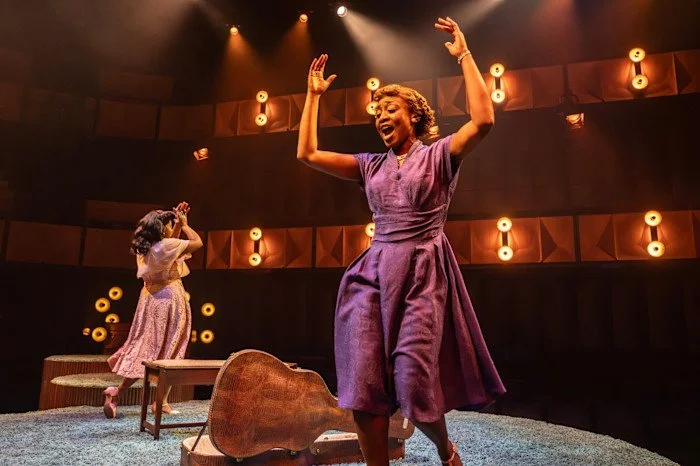
Visually, the production is a success. Lily Arnold’s set design creates an evocative, intimate space that feels both expansive and claustrophobic when needed. This is complemented beautifully by Jodie Simone-Howe’s costuming, which captures the era's texture with striking precision. Without spoilers, I have to applaud the use of the design and technical elements to hint at what’s to come. The dark wood and electric blue shag carpeted floor isn’t evocative of 1946, but it was evocative of another, incredibly relevant time period. One of the more fascinating elements of the evening was the sensory immersion. Throughout the performance, I noticed subtle shifts in the room's temperature. While I cannot be certain if this was a deliberate choice to foreshadow the late-stage twist, it felt like an incredibly clever use of the senses. Theatre is a present, living medium; while we aren't invited to use touch, utilising feeling and smell is an underused tool that, when implemented this effectively, really emphasises the unique nature of theatrical storytelling.
Jacob Sparrow has proved once again why he is one of the best casting directors in the business. The chemistry between Beverley Knight (Rosetta) and Ntombizodwa Ndlovu (Marie) is the heartbeat of the show. Delivering a performance of immense wit and charisma, Knight handles the transition between Rosetta’s public bravado and private vulnerability with ease. Ndlovu provides the perfect foil; there is something deeply sympathetic about her Marie. She makes you feel for the character in your gut, navigating the highest of highs and the lowest of lows without missing a beat. The music, of course, is the primary draw. I can’t think of two performers better placed to tell this story through song. Their voices blend with a raw power that makes the lack of an announcement of a planned cast recording feels like a genuine travesty.
Despite the vocal brilliance, the production falters in its physical language. The movement direction felt somewhat generic - a standard blend of rock and roll tropes that didn't quite capture the specific heat and soul of 1946 Mississippi. Furthermore, I couldn't help but feel the show would have been elevated by an "actor-muso" approach. Having the pair mime their respective instruments - Marie on piano and Rosetta on guitar - while a hidden band played felt like a missed opportunity. Seeing the music brought to life by the actors themselves would have added to the experience in a way that for me the miming didn’t. I was also perplexed by a sudden directorial shift about 75% of the way through. An off-stage guitarist suddenly joined the duo, acting as a shadow to Rosetta. While the coordination was impressive, it was a device introduced late, used once, and never revisited, making it feel more like a distraction than a meaningful addition.
The script aims to restore Sister Rosetta Tharpe to her rightful place in the history books. However, the ending feels counterproductive to that mission. As the story wraps up, we are met with a twist and a list of the famous men she inspired. While the intent is to show her influence, it resulted in one of the final beats of the story being wrapped up on men we already know, rather than just about her. Rosetta is a formidable enough musician to stand on her own; she doesn't need the validation of those who benefited from her sound to prove her worth. Why am I leaving the theatre thinking about those men rather than the woman I’d just spent two hours getting to know?
Even with a final 15% that doesn't quite match the strength of what precedes it, Marie and Rosetta is a brilliant evening of theatre. It is a loud, proud, and soulful exploration of a pioneer, led by two of the finest voices I’ve ever heard on a London Stage.
Marie and Rosetta runs until April 11th at @sohoplace