John Proctor is the Villain - Royal Court Theatre: A magnificent bit of theatre at 28, that would have changed me at 17
⭑⭑⭑⭑⭑ - 95% • 7 minutes 45 seconds read time
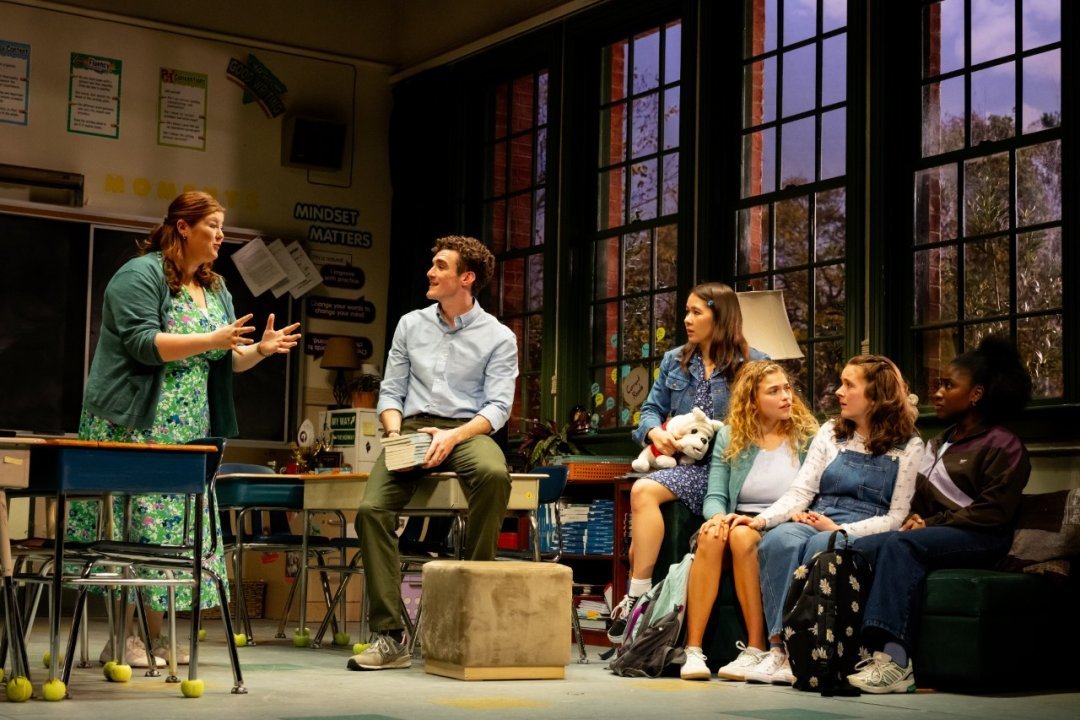
John Proctor is the Villain at the Royal Court was the hottest ticket in town as soon as the news dropped that it would be transferring to London after its sell out run on Broadway last year. It was near enough sold out before they even announced a single cast member, and having now seen the show I can understand why. This was a magnificent piece of theatre that at 28 I haven’t stopped thinking about since the second it ended. But if I had seen this when I was 17? I’d go to my grave still telling people about the night in the theatre that changed my life.
On the very surface, the play is pitched as a critical look through a modern lens at American classic The Crucible, set during the Salem Witch Trials, questioning the idea of if John Proctor really is a hero for the choice he makes at the end?
But this really is just the framework for what, to me, is much more about the exploration of girlhood. The question isn’t so much “Is John Proctor the Villain?” and is more about a group of teenage girls taking their first steps into critical thought and analysis, asking the question “Why, after 300 years, are we still making excuses and justifications for men who abuse their power, whilst simultaneously demonising women and girls for simply existing?”
Because what becomes clear very quickly is that it’s always the same men. The men, and the behaviours of men that women were contending with in 1690 were the same men that women were contending with in 1950, are the same men these girls are contending with in 2018. And the excuses used to justify the behaviours of those men has always been the same.
John Proctor and the value put on his name and reputation reminded me of the 2016 case against Brock Turner. A college athlete at Stanford University who raped an unconscious woman at a party in 2015, was found guilty on 3 felony charges, but was sentenced to just 6 months. Why? The judge took the victims own words and twisted them - saying the damage is done, why further cause this Ivy League athlete further distress when he’d lost so much already? 66 years on from Arthur Miller writing the book, and 324 years removed from John Proctors world, and how much was really different?
We have rights today that women and girls in 1692 could only dream of, and yet the narrative paths our lives take are so similar. Still taught to be small, still taught to be quiet and not take up space, don’t draw attention to yourself - and if you do then the consequences of that are on you, you wanted it, you encouraged it. Why would you wear that, say that, drink that, be there, exist, if this wasn’t the outcome you wanted? We have rights they could only dream of and yet we still haven’t reached the new world that was promised.
But in the face of such violence, such entitlement, such grotesque abuses of power, girlhood perseveres. And there’s beauty in it for a multitude of reasons but the biggest one for me is that it holds a mirror up to the violence of patriarchy and shows them what strength really looks like. It’s not brute force, it’s not taking what was never offered and thinking that makes you the big man, it’s not screaming and intimidation.
Real strength is the way in which women and girls hold each other close and lift each other up, dancing in the forest under the moon because that’s what it is to be alive. To move through the world with your guard up because that’s the only way to stay safe, but to create spaces for softness, for community, for love. To be knocked down, hurt and betrayed over and over but to always keep rising.
They are 16 and they are learning that the world is not kind, or gentle, and girlhood will get them through this life, and one day they’ll be 76 and look back on all the times the women around them held them up, and the times they did the same in return.
They are also 16 and learning a lesson that Stephen Sondheim said best -
“Take extra care with strangers
Even flowers have their dangers
And though scary is exciting
Nice is different than good”
Fair warning - spoilers from here on out.
I don’t know that this play would work so well if Mr Smith was any other type of teacher. And I don’t mean because they need the English lit classes to provide the bones of the story. I mean because whilst all teachers have the capability of abusing their powers, English teachers are uniquely positioned to take advantage of the vulnerabilities of teenage girls.
Ask the women in your life who their first crush was, and if they had a male English teacher, chances are they’ll say them. Why? I don’t imagine English teachers are disproportionately attractive compared to the wider faculty. No, I think it’s because a perfect storm is created and they sit at the eye of it.
As I mentioned earlier, and as is spoken about in the play, we teach our girls to be small, we teach them not to take up space, we teach them to speak when spoken to, we teach them not to be too loud, too outspoken, too big, too much. And so stepping into young adulthood with all of that fear and anxiety about simply existing, makes finding your voice both daunting and also visceral. It’s an ache to be seen to matter.
And other classes don’t offer that. For all that progress is being made, Maths, Science and Tech are still very much treated as the boys domain. When girls are good in those classes, they aren’t spaces where they always feel like their value is seen, and often they feel even smaller by being good at it, they feel a need to hide how good they are.
But in English class, the point is to have a voice. To think for yourself, to discover how you feel about something and to share it with confidence. Being an individual person is valued, and it’s happening at exactly the age where all you want is to be seen, valued, and treated like you matter.
For a lot of young girls, the English teacher is the first person not related to them to show them that kind of attention. And we can intellectualise it as much as we like, but the reality is we are animals. And having someone of the gender you are attracted to showing genuine interest in you is intoxicating - especially when you’re 15 and more hormones than anything else.
It’s an often complicated and intense dynamic that isn’t often replicated in other teacher-student dynamics, and it’s what positions the worst of them so perfectly to take advantage, and to get away with it.
Which is another thing this play tackles beautifully - the idea not just of a perfect victim, but also of a perfect culprit. It even plays on those past connections in the audience. I’m a grown woman who is, naturally as the vast majority of us are, distrustful of men. And yet, despite feeling something off from jump, I wanted to believe that Mr Smith genuinely did just really care about his job and his students. Would I have given that grace to any other sort of teacher? I don’t know, but I don’t think so.
It works because it presents us with a man who is so respected, so soft spoken, so kind, positions himself as caring about women’s rights and furthering progress, so genuine that when an accusation is levelled at him - what do you do? Dónal Finn has an incredibly difficult job to do, pitching the tone of the character right to maximise the emotional hit of the twist. But he lands it bang on the money, not just for the twist to hit hard, but for the complexity of how your emotions towards him have to change from that moment on.
The play presents this battle between our ideals and our hearts. Of course in the theoretical, we all want to say we believe women, we believe victims. But even those most deeply tied to their ideals have them tested when sticking to them means believing someone you love could be someone you never would have imagined. What do you do when the accused is the teacher that makes you feel safe, or your dad, or your brother’s friend that was always kind to you? Suddenly the heart makes it a lot harder to stick to black and white ideals. Suddenly you’re 16 and you realise a lot of the world is actually grey. Not in what is right and what is wrong, but in how we navigate it when wrong shows up on our doorstep.
I’m not sitting here telling you that it’s one of the finest works of feminist critique in the modern day. It’s not - a lot of the ideas are surface level, it’s not presenting any grand theories or concepts that aren’t already widely discussed. But it is perfectly placed for the people telling this story.
It is a perfect capture of what it felt like to be a 16 year old girl, starting to question the world, starting to question your place in it, starting to question how it can be better and why it isn’t already. And it’s delivered note perfectly by a cast you all need to keep an eye on. Three of the cast are making their professional stage debut in the production, and the majority are still in the first 5 professional productions they’ve ever been part of. But the quality of acting they displayed you’d be hard pressed to find in a company made up of seasoned professionals decades deep into a career.
I couldn’t even say to you that there was any one standout performance - they were all storytelling like their lives depended on it. Though it has to be said - Sadie Soverall has an incredibly hard job with the sheer intensity of emotion she needs to bring every show for the play to work. This is only her second theatre job, and she navigates it with skill I’d expect to see in a much more practiced performer.
I would love to encourage you to get a ticket, but it is in fact sold out. So instead I encourage you to join me in championing a West End transfer for a much longer run, because my goodness what a show. If I had seen it whilst I was studying for my A-Levels, I would have rushed into class today declaring myself ready for the exam because I knew exactly what I was going to write about, for I had just last night had my life changed in the theatre.