Evita - The London Palladium: Performances with bite, in a production that’s bland
⭑ ⭑ ⭑ - 65% • 5 minutes 55 seconds read time
Three stars. 65%. That’s where I land with Jamie Lloyd’s latest, Evita at the London Palladium. It’s a show with phenomenal performances and a fierce band at its back, but also one that left me cold – again. And the trouble is, I’ve started to realise that this feeling is becoming a pattern. Because when I leave a Jamie Lloyd production, more often than not, I’m not stirred or moved or shaken. I’m perplexed. This time, I left and my main thought was: Does this man actually like theatre? Because to me, his work doesn’t feel like a celebration of theatre – it feels like a rejection of so many of the things that make theatre so brilliant.
But before we dig into that, let’s be fair – there is a lot to celebrate here, and it’s all in the performances and the music.
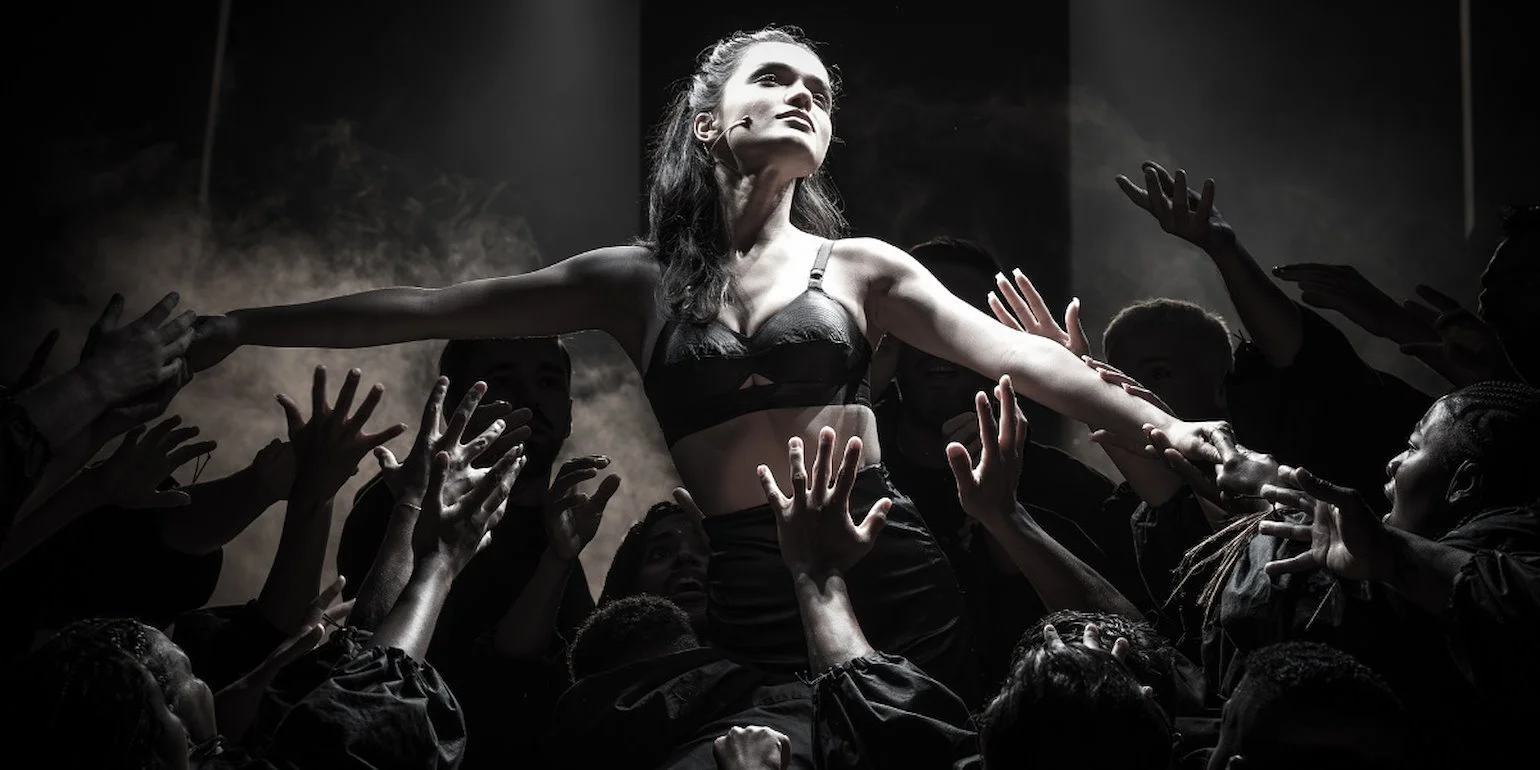
Rachel Zegler is an absolute dream as Eva Perón. Think of this: she’s 24, completely untrained, and yet delivers a vocal performance with the weight and polish of someone twice her age. It’s baffling in the best way. Some performers are simply born to do it – and Zegler is one of them. Her Evita is bold, hungry, shrewd. She’s got attitude in spades and more than a touch of villainy, never asking us to like her, only to watch. When she belts, “You oughta know whatcha gonna get in me! Just a little touch of star quality!” in Buenos Aires, that’s a promise. A sworn certainty. She’s got star quality coming out of her ears. Whatever else I felt about the production, I cannot recommend highly enough getting a ticket to see her in this role.
James Olivas as Juan Perón matches her energy with rich vocals and a gravity that the role demands. He’s intense, commanding – you believe his authority, even without the traditional age gap between the characters. That gap (Evita was 33 when she died, Juan 57) is part of what gives the ending its deep ache however, and their youthfulness together slightly dulls the impact of quite how young Eva is when she dies. Regardless of that, their chemistry – especially in I’d Be Surprisingly Good For You – still fizzes.
But the star of the show, for me, is Diego Andrés Rodriguez as Che. His performance has teeth. It’s sharp, burning with the frustration of the working class, layered with sarcasm and soul. He goads, mocks, questions – shifting tone and stance like a shapeshifter. There’s something magnetic about him, and his presence lends the show its moral spine. You can’t help but watch him.
More than that, Rodriguez brings not just intensity, but charm, morality and a raw determination that grounds the entire piece. His Che isn’t simply a narrator or an observer – he’s a voice of resistance, a force of reckoning. I could feel within him the desperation for justice I see in so many vocal opponents of fascism every day. Diego’s interpretation felt achingly relevant – he captured the heartbreak and fury of watching systems fail the people they’re meant to serve.
Some of Lloyd’s choices, narratively, make the role of Che a little unclear. Is he a literal person, or figurative? Is he the voice of reason? Is he Eva’s conscience? There’s no real commitment to one version, and it can leave the character’s function feeling a bit vague. But despite this, Diego manages to cut through. He grabs you, pulls you in and says: watch me. hear me. And we do. He’s impossible to ignore – all fire and ferocity, asking the questions the production itself doesn’t always bother to answer.
Musically, this Evita is a rock show through and through. The orchestrations are punchy, brash and bold – at times we’re one head bang away from a full-blown rock concert. The band is phenomenal, and the choreography plays with the tension in all the right places, offering moments of physical punctuation where the staging often doesn’t.
But now to the why of my 65%.
Despite the cast’s commitment and the musical brilliance, I found myself bored. Not due to the material, and certainly not due to the talent onstage – but because of Lloyd’s now-familiar directorial choices. I go to the theatre to feel. To be moved, provoked, inspired. Instead, what I got was a distancing effect that left me detached. It’s become clear to me that whatever Jamie Lloyd is trying to say with his work, I’m not receiving it on my frequency.
There’s a particular move he pulls – and he pulls it often – where emotionally charged scenes are played entirely front-facing. The actors are rooted to the spot, staring straight out at us, delivering dialogue with no connection to the person they’re speaking to. That’s not a celebration of acting. That’s a rejection of it. It erases the electricity that sparks when actors play with each other, not away from each other. Imagine Zegler and Olivas in the Vice President scene – the impact they could have had if they were allowed to act across from one another, not adjacent to us like mannequins on display.
Staging, too, feels like an afterthought. Yes, minimalism can be powerful – but this doesn’t feel like a focused design decision. It feels like a lack of one. Where’s Buenos Aires? Where’s the heat, the colour, the clash of culture and power? The costumes - though more interesting than much of his previous work - still largely are just blacks, greys, whites. Shorts and vests, trainers and t-shirts. It leaves the characters in an emotional and visual void.
I’ll be honest, if not for the movement, I could have closed my eyes and lost nothing – because there’s very little to see. And to me that feels like Jamie Lloyd isn’t putting on a production. He’s just doing a slightly elevated concert.
And then there’s the gimmick. And yes, I do mean gimmick – “a trick or device intended to attract attention, publicity, or trade.” That definition is key, because so many fans push back on the idea that Lloyd’s work is gimmicky, but the label fits. And that isn’t to say you can’t or shouldn’t enjoy it. Live your life. It can be a gimmick and still be entertaining to people. But his star casting on a public facing balcony singing the biggest number of the show, drawing crowds who can film and post online? It’s a gimmick.
We go through the whole of Act One without a screen in sight, and then Act Two arrives and suddenly we’re in live-stream land. Zegler sings Don’t Cry For Me Argentina from a balcony facing the public outside, being filmed and broadcast on a giant screen to us inside the theatre. The irony of course is that the crowd outside gets it for free, and they’re allowed to film and post it online. Inside, where we’ve paid for the ticket, we’re forbidden from filming the very screen that’s showing a performance we’re no longer truly part of. It’s clever marketing – of course it is. Lloyd knows exactly what he’s doing. But it doesn’t deepen my theatrical experience.
And therein lies my frustration. Jamie Lloyd is a sharp marketer, a brand in himself, but I can’t help but feel that his productions have started to blur together. Sunset Boulevard felt barely different from Cyrano. Romeo and Juliet wasn’t far off from Sunset Boulevard. Romeo and Juliet shares far too much DNA with Evita. Each new production feels like an echo of the last. The same black box, the same camera, the same detached staging, the same sense that we’re watching a concept rather than a story.
And to me that isn’t creativity. It doesn’t strike of ingenuity. It doesn’t feel inspired or boundary pushing. It feels like a repetitive attempt to prove he can make theatre without indulging in the theatrical.
What’s most frustrating is that this cast could have given us something extraordinary. With different direction – with colour, with staging, with human connection, with warmth – this could have been a five-star Evita. But instead, for me I’m left with fragments of brilliance, scattered across a sparse canvas.
Of course, theatre is subjective. Go and see it. Make up your own mind. There’s magic in Zegler’s performance, power in the band, fire in Rodriguez’s Che. But for me, as someone who loves theatre for its heart, its dynamism, its life, I left the London Palladium wondering – again – what we might have had, if Jamie Lloyd wasn’t so determined to deny us so much of what makes theatre feel like theatre.